Geopolitical analysis of the Maghreb from Spain's perspective.
MAGRINT was born from a calling, not a commission. It comes from a gaze that has been fixed for years on the other side of the Strait, trained in intelligence analysis and open sources, and from one conviction: what happens in the Maghreb eventually reaches our shore. Who stands behind it matters less than what is told.
We live in a difficult historical moment. Tension on the southern flank of Spain and Europe keeps growing: migratory pressure, regional rivalries, energy crises, jihadism in the Sahel and foreign powers seeking their place in Africa. And yet this reality is still told late, in fragments or from afar.
That is why we do what we do. Because we believe that understanding is the first form of defence, and that Spain needs to look south calmly, knowledgeably and without prejudice. MAGRINT is our way of shining a light on this matter: explaining what happens, why it happens and what it means for us.
"Whoever understands the Strait understands much of Spain's future."
The Strait has never been a border: it has been a gateway. Merchants, armies, scholars, empires and legends have passed through it. It has been a route of trade and civilisation, but also the stage for some of the greatest tensions in the Mediterranean.
According to myth, Hercules opened the passage between the inner sea and the ocean, separating Calpe (Gibraltar) and Abyla (Ceuta or Jebel Musa). For centuries they marked the edge of the known world: Non terrae plus ultra.
Plato places beyond the Pillars a powerful island that ruled part of Libya (North Africa) and Europe. Many have seen in it an echo of the Andalusian Atlantic or of the Moroccan coast: a myth, but a myth born here.
In the lower Guadalquivir flourishes the first great civilisation of the West, rich in silver and metals and open to trade with the whole Mediterranean. Its legends speak of kings such as Gargoris, Habis and Arganthonios.
They found Gadir (Cádiz) on one side and Lixus and Tingis (Tangier) on the other. The Strait becomes a single trading network: two shores, one sea.
The Punic power controls both shores and turns the Strait into its key to the Atlantic, until it clashes with Rome in the Punic Wars.
Hispania and Mauretania Tingitana are united under one power. For a time, northern Morocco even depends administratively on Hispania: two shores as a single province of the empire.
The Vandals cross into Africa from southern Iberia; Byzantium settles in Septem (Ceuta); the Visigoths rule Hispania. The passage remains coveted by all.
Tariq ibn Ziyad lands at Gibraltar (Jabal Tariq, "Tariq's mountain"). Almost eight centuries of Al-Andalus begin, during which both shores share language, art, science and power.
Berber dynasties born in Morocco rule Marrakesh and Seville at the same time. The Giralda and the Koutoubia are sisters. After Las Navas de Tolosa (1212), the balance tips towards the Christian kingdoms.
Castile and the Marinids fight over the passage (battle of Río Salado, 1340). Portugal takes Ceuta in 1415. Granada falls in 1492 and the frontier moves to the sea.
Castile occupies Melilla (1497). Ceuta passes to the Spanish Crown and the Treaty of Lisbon (1668) confirms its Spanish sovereignty.
Hundreds of thousands of Moriscos are expelled and settle in Morocco, Algeria and Tunisia. To this day there are Andalusian surnames, neighbourhoods, music and recipes on the other side of the sea.
Barbary corsairs and Spanish campaigns shape the western Mediterranean. In 1704 England takes Gibraltar and the Strait acquires a third key.
Spain wins at Tetouan and Wad-Ras. A direct involvement in Morocco begins that will mark the following century.
The Algeciras Conference divides influence over Morocco. In 1912 Spain receives the northern protectorate, with its capital in Tetouan, and France the rest.
Abd el-Krim defeats the Spanish army at Annual (1921), one of the worst military disasters in Spanish history. The Alhucemas landing (1925) and joint action with France end the war.
The Spanish Civil War begins, to a large extent, in the Protectorate. Thousands of Moroccan soldiers fight in the peninsula: another shared, and painful, imprint.
Morocco regains its sovereignty in 1956. The Ifni War (1957-58) follows, and Ifni is handed back in 1969.
With Franco dying, Morocco organises the Green March. The Madrid Accords end the Spanish presence in Western Sahara and open a conflict with the Polisario Front, backed by Algeria, that lasts to this day.
The Maghreb-Europe (1996) and Medgaz (2011) pipelines link Algeria with the Iberian Peninsula. Energy becomes another thread between the two shores.
An uninhabited islet brings Spain and Morocco to the brink of a military clash. US mediation returns the situation to where it started.
Regimes fall in Tunisia and Libya; Libya fragments. In the Sahel, military coups follow one another (Mali, Burkina Faso, Niger), France withdraws and Russian mercenaries arrive. Jihadism advances towards the Gulf of Guinea.
More than 10,000 people enter Ceuta in May 2021. In 2022 Spain backs Morocco's autonomy plan for the Sahara as the most serious basis for resolving the conflict; Algeria responds by suspending its friendship treaty with Spain.
The UN Security Council endorses autonomy under Moroccan sovereignty as the basis for negotiation. Spain, Morocco and Portugal are jointly preparing the 2030 World Cup, and the old project of a tunnel under the Strait is revived. At the same time, migratory pressure, competition for energy and instability in the Sahel keep the southern flank under tension.
Three thousand years later, the question remains the same: will the Strait be a wall or a bridge?
Our mission is to explain rigorously what happens in the Maghreb and the Sahel and what it means for Spain: security, energy, migration, trade and diplomacy.
And we stand for one idea: Spain and Morocco need each other. They are two nations that history has forced to understand one another, sometimes in good ways and sometimes in bad. We share a Mediterranean character, centuries of common culture, thousands of words of Arabic origin in our language and a folklore that recognises itself in music, cuisine and a way of living. Despite religious differences, what unites us is greater than what divides us.
Solid cooperation and a strategic alliance between both countries would turn the Strait into an axis of stability and prosperity with weight across the whole Mediterranean. Helping this to be understood, through knowledge and not fear, is part of our mission.
We apply to public sources the same method used by analysis services: an orderly cycle that goes from the question to the conclusion.
We define what we need to know and why it matters to Spain.
We gather open sources: local press in Arabic, French and Spanish, official documents, data and social media (OSINT).
We cross-check, separate facts from opinions and assess the reliability of every source.
We publish clear conclusions in video, text and social media, citing where every piece of data comes from.
We continuously follow five key theatres for Spain's security and interests.
Bilateral relations, Ceuta and Melilla, Western Sahara, migration and trade.
Gas and energy, rivalry with Morocco and foreign policy.
Political drift, economy and migration routes to Europe.
Fragmentation, foreign actors and control of the central Mediterranean.
Jihadism, military coups, Russian presence and spillover to the north.
MAGRINT materials, free and open to all. We start with language, because understanding each other starts there.
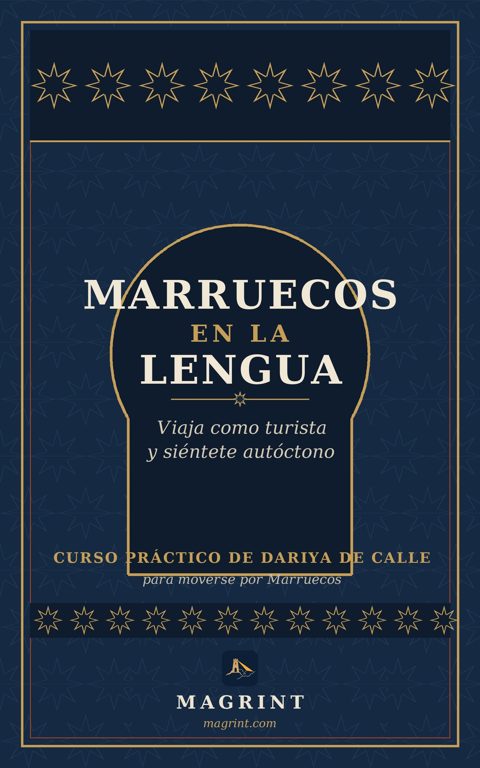
A practical course in Darija —the Arabic spoken on the streets of Morocco— written for Spanish speakers, and a bridge between both shores: the words, the history, the music and the table we have shared for over a thousand years.
Readable with Apple Books, Google Play Books, Thorium (Windows/Mac) or any EPUB reader. You can also send it to your Kindle.
MAGRINT receives no money from governments, parties or companies. It is sustained by those who read and watch it. Every contribution pays for sources, tools and hours of analysis.
A card contribution, for the amount you choose and without registering. Secure payment with Stripe.
Secure payment on Stripe's page.
For those who prefer full privacy: no card, no bank, no public trace.

8Aq6Uboo4mh3Qh8vUs8NZdiDnuRMTdCxLFkPxiUXhvh6JmDBvprFMGdFyDCRxgBYXhE4YvDpguF1hE38iJsSpZU72X3SW5r
Do you have information, a correction or a collaboration proposal? Write to us. Every message is handled with discretion.
contacto@magrint.com MAGRINT